
How Portfolio Rebalancing and Tax-Loss Harvesting Help Austin Wealth Management Improve Client Outcomes
Behind every AWM advisor is a dedicated team of investment professionals meticulously looking at each client account and watching for opportunities to improve client investment performance. Two critical strategies we employ are portfolio rebalancing and tax-loss harvesting.
What is Portfolio Rebalancing?
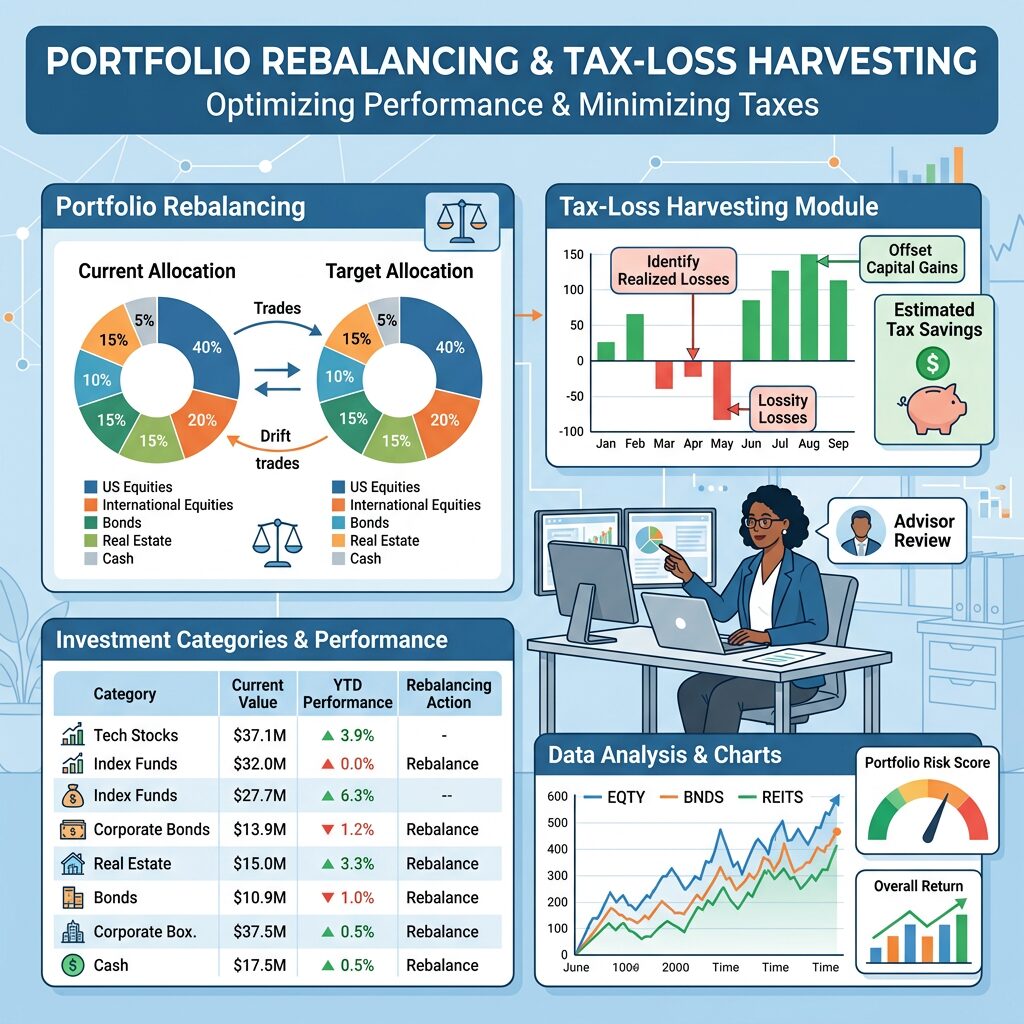
Portfolio rebalancing is the process of adjusting your investment mix to maintain your target asset allocation. Over time, market movements cause some investments to grow faster than others, shifting your portfolio away from its original allocation.
For example, if your target allocation is 60% stocks and 40% bonds, and a bull market pushes stocks to 70% of your portfolio, rebalancing involves selling some stock positions and buying bonds to restore the 60/40 balance.
Benefits of Regular Rebalancing
1. Risk Management
Maintaining your target allocation ensures your portfolio’s risk level remains consistent with your goals and comfort level.
2. Disciplined Approach
Rebalancing forces a “buy low, sell high” mentality by requiring you to sell outperformers and buy underperformers.
3. Long-Term Performance
Studies show that regularly rebalanced portfolios tend to perform more consistently over long periods.
Understanding Tax-Loss Harvesting
Tax-loss harvesting involves selling investments that have declined in value to realize losses that can offset capital gains and potentially reduce taxable income.
Here’s how it works:
1. Identify investments with unrealized losses
2. Sell them to realize the loss
3. Use the loss to offset capital gains from other investments
4. If losses exceed gains, deduct up to $3,000 of losses against ordinary income
5. Carry forward any remaining losses to future years
Important Wash Sale Rules
The IRS prohibits buying the same or substantially identical security within 30 days before or after a loss sale (the wash sale rule). At AWM, we carefully navigate these rules by:
– Replacing positions with similar but not identical investments
– Tracking holding periods meticulously
– Documenting all transactions for tax purposes
The AWM Advantage
Our investment team continuously monitors client portfolios for:
– Rebalancing opportunities aligned with market movements
– Tax-loss harvesting opportunities throughout the year
– Coordination between investment strategy and tax planning
– Cost-effective execution to minimize trading costs
A Concrete Example
Consider a client with a diversified portfolio that experienced significant market volatility. Our team identified:
– Overweight technology positions (70% of equity allocation vs. target 40%)
– Tax-loss harvesting opportunities in underperforming positions totaling $25,000 in losses
We:
1. Rebalanced by selling excess tech positions and buying underweighted sectors
2. Harvested tax losses to offset capital gains from earlier in the year
3. Used remaining losses to reduce ordinary income by $3,000
The result? The client maintained their target allocation while improving their tax situation by approximately $7,500 in tax savings.
Bringing It All Together
Effective wealth management requires a holistic approach that considers investment strategy, risk management, and tax efficiency. At Austin Wealth Management, our team works together to implement these strategies consistently and thoughtfully.
If you’re curious about how portfolio rebalancing and tax-loss harvesting could benefit your portfolio, schedule a consultation with our team.
More Articles

New 2026 IRS Limits: Bigger Breaks, Bigger Planning Opportunities
The IRS and Social Security Administration have released key numbers for 2026, including new federal income tax brackets, a higher standard deduction, bigger retirement and HSA contribution limits...

Charitable Giving 101: A Beginner's Guide to Tax-Smart Donation Strategies
The holiday season is upon us, and with that often comes a desire to give back. Whether through volunteering your time, sharing your expertise, or donating resources like clothing, food, and money...

SpaceX IPO: What Investors Need to Know
SpaceX is going public in one of the largest IPOs in history. Austin Wealth Management breaks down the valuation, the risks, and three investing scenarios — from pre-IPO allocation to long-term index exposure.