

SpaceX IPO: What Investors Need to Know
SpaceX is Elon Musk’s rocket and satellite business, which includes his AI company. SpaceX is going public, and it is a big deal.
This event is referred to as an IPO (initial public offering). The purpose of this IPO is to raise $75 billion from investors by selling shares to the public. That would make it the biggest IPO in history by more than 3X — for reference, Alibaba raised $22B in 2014.
SpaceX estimates their total addressable market to be $28.5 trillion. Most of that estimate is related to AI infrastructure and enterprise products. They have even more ambitious goals of developments on the Moon and Mars. Elon Musk has a strong track record of opening new markets and building fast at massive scale, so the excitement around this company is understandable. Of course, those lofty goals come with major risks.
The price tag to buy SpaceX stock implies a valuation of 100X revenue, meaning the investor pays $100 in stock price for every $1 of revenue generated by SpaceX. To put it in perspective, the S&P 500 has about a 4X revenue multiple, and NVIDIA has a 20X revenue multiple.
It is important to know that an IPO is a sale. The founders, employees, and institutional investors are selling their shares. SpaceX hired investment bankers Goldman Sachs to set the IPO price, hype up the sale, and make the public excited to buy. If Goldman Sachs set the price too low, they have left money on the table for their client. If they set the price too high, they may not sell as many shares as they planned.
So how does that typically work out?
The First-Day Pop
When a company goes public, its stock price often surges on the first day of trading — historically by an average of 19%. This first-day pop typically goes to Wall Street, not the general public. Most IPO shares are allocated to institutional investors and preferred clients at the set IPO price; by the time the stock is available to the general public, the price has already made the jump.
SpaceX is a little different in this case. They are making an allocation of shares available to regular investors at Charles Schwab and Robinhood. More on this below.
The Three-Year Cliff
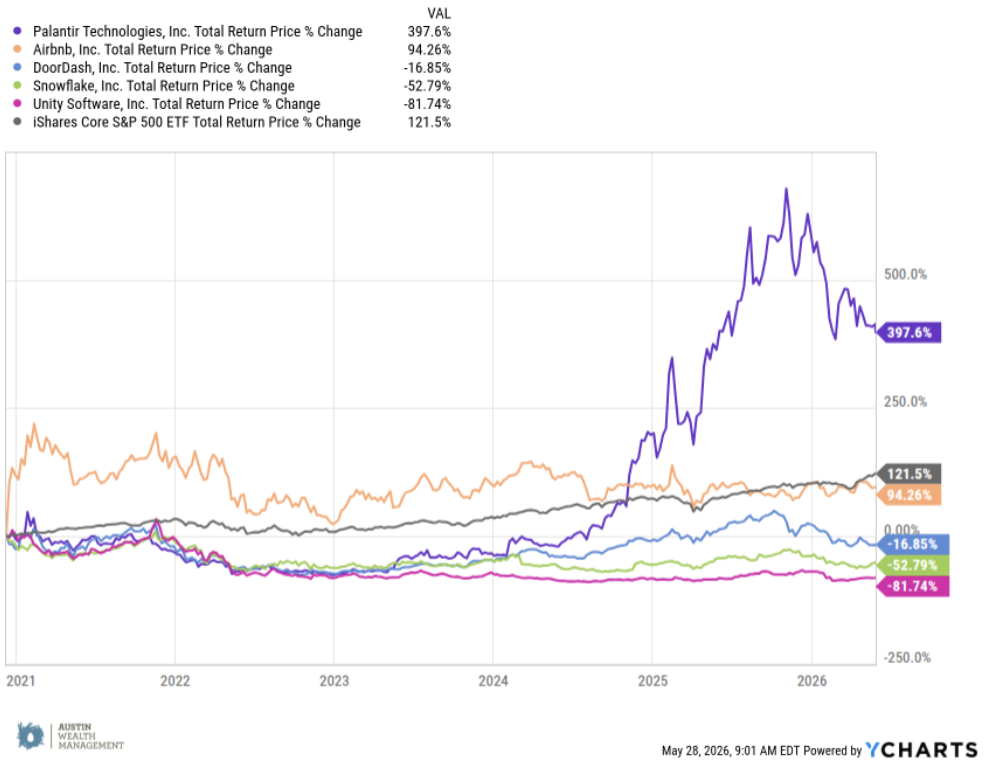
The average IPO underperformed the S&P 500 by -6% per year over the first 3 years, and 60% of IPOs lost value over the first three years. We can observe this reality by looking back at the biggest IPOs in recent years. In each case, a few years after the IPOs, there was one winner and mostly losers.
2019: Winner: Spotify | Losers: Lyft, Snap, Pinterest
2020: Winner: Palantir | Losers: Unity, Snowflake, DoorDash
2021: Winner: Robinhood | Losers: Lucid, Rivian, Roblox, Coinbase
The Facebook Lesson
Thinking about the most successful IPOs in recent history, Facebook comes to mind. Their 2012 IPO turned out to be a wild success in the long term, but the first year was rough — Facebook was down 32% vs. the S&P 500 up 32%. But by the end of three years, Facebook was well ahead of the S&P 500.
The lesson here is that a great long-term business may not have a successful IPO trading event. In the case of Facebook, investors would have been better off dollar-cost-averaging into the stock.
SpaceX Investing Scenarios
Pre-IPO (FOMO/YOLO Speculation)
There is a chance this stock goes to the moon (pun intended) from its pre-IPO price to the opening day price, and you may be inclined to gamble on that possibility. You may want to alleviate yourself from the possible regret if you don’t try. Charles Schwab and Robinhood can give you a chance to receive a pre-IPO allocation of shares. We expect the odds of actually receiving an allocation to be very low, because few shares will likely be available to general investors — but it is possible. This is a rare and unusual situation; most IPOs do not make shares available to anyone other than institutional investors and their select clients.
Speculating on single stocks is not part of our investment strategy for our clients, so we will not be setting up client accounts to apply for a pre-IPO allocation of shares. However, you are free to do this on your own. Here are the instructions using Charles Schwab:
1. You must have at least $100k with Charles Schwab to be eligible.
2. Open a “retail” account at Charles Schwab. This account will show up next to your other accounts, but we will not be involved in its management.
3. Complete a FINRA 5130/5131 eligibility questionnaire through the Charles Schwab website.
4. Submit a conditional offer to purchase to Charles Schwab, stating the maximum number of shares you want to buy. Make sure you have enough cash available in your account to execute the purchase.
5. After the price is set, log into Schwab to affirm your order. If you don’t do this, you will not receive an allocation.
6. You will receive your allocation on opening day.
Opening Day (Speculative Trading)
The general public will be able to buy and sell shares on opening day (probably mid to late in the session). The price volatility may be extreme, so any transactions must be considered speculative. If you want to engage in this trading, please do so with a personal account that we do not manage.
Long-Term Investing
If SpaceX turns out to be a great investment, it will more likely be a result of long-term compound returns rather than IPO trading returns. With that perspective in mind, investors don’t need to worry about the IPO activity.
Stock indices will likely add SpaceX to their lists, at which time most investors will naturally begin investing in SpaceX. The index providers are already talking about making concessions to add SpaceX earlier than they typically would. When the stock is added to the S&P 500, many U.S. stock-focused investment funds will begin investing in SpaceX. Because a portion of our clients’ portfolios are based on the U.S. stock market index, they will naturally invest in SpaceX when it is added to the index. Some funds may add it before the index listing.
Facebook was added to the S&P 500 in 2013, about a year after its IPO. Any investor with exposure to the S&P 500 — and likely just about any ETF or mutual fund focused on U.S. stocks — has participated in the growth of the company’s value, which has been phenomenal.
Our preferred strategy for investing in stocks is to buy more of them when they are priced favorably compared to their fundamentals: profits, revenues, cash flows, etc. We prefer to own less of them when they are expensive compared to those fundamentals. In the case of SpaceX, because of its massive price-to-revenue ratio at the starting price, our strategies will be more likely to add it to portfolios if the price drops considerably.
— Kevin Smith, CFA® | Austin Wealth Management
More Articles

Final Countdown: Your Year-End Contribution and Transaction Deadlines
December is a good time to review deadlines for contributions, distributions, charitable giving, and account updates. Many account actions must be completed before December 31...
How Portfolio Rebalancing and Tax-Loss Harvesting Help Austin Wealth Management Improve Client Outcomes
Behind every AWM advisor is a dedicated team of investment professionals meticulously looking at each client account and watching for opportunities to improve our clients investment performance...

New 2026 IRS Limits: Bigger Breaks, Bigger Planning Opportunities
The IRS and Social Security Administration have released key numbers for 2026, including new federal income tax brackets, a higher standard deduction, bigger retirement and HSA contribution limits...